
Degree awarding powers
Application and assessment
To apply for degree awarding powers, providers need to complete the OfS application form, available through the OfS portal.
We will then schedule an assessment for degree awarding powers. Once scheduled, we will assess the provider's eligibility and suitability.
If the provider is eligible, we will brief it on the arrangements for the assessment. This will include indicative timeframes and submission requirements.
For New DAPs, providers must submit a detailed plan and evidence showing how they will meet the criteria by the end of the probationary period.
For Full DAPs, providers must submit evidence showing how they meet all criteria at the point they apply.
Tips on how to prepare your submission
Our guidance on how to apply explains in detail what providers will need to do. But we have also listed some top tips on how to prepare:
- Structure your self-assessment by each criterion and underpinning evidence requirement. Use narrative and evidence to clearly set out how you meet (or intend to meet) the criteria and all evidence requirements.
- Clearly map out which evidence relates to which criterion and evidence requirement, ideally both in your self-assessment in an accompanying evidence index.
- Use a unique reference number for each piece of evidence you upload.
- Be clear about whether you are still working on evidence or developing it, and when the evidence will be finalised.
- Apply the 'PEE' model: provide the ‘Policy’, ‘Explain’ how it works in your context, and ‘Evidence’ it in practice.
- Ensure that evidence ‘shows’, rather than ‘implies’ – for example, committee minutes which reference a student survey (implies) versus also providing the survey and subsequent action plans (shows).
- End-to-end examples and case studies can be very useful – for example, to demonstrate the process of programme development, approval and implementation.
- Ensure New DAPs plans set out the detail of how you will implement plans, as well as by when (for all criteria).
- Clearly set out current versus future plans with evidence – especially if you are moving away from current policies or procedures in place through validating partners.
- Prepare for how you will enable access for assessors to your physical and virtual learning environments or systems (including access to assessments and feedback).
Assessment
Once we receive an application and start our assessment we follow various stages. We have outlined these stages below:
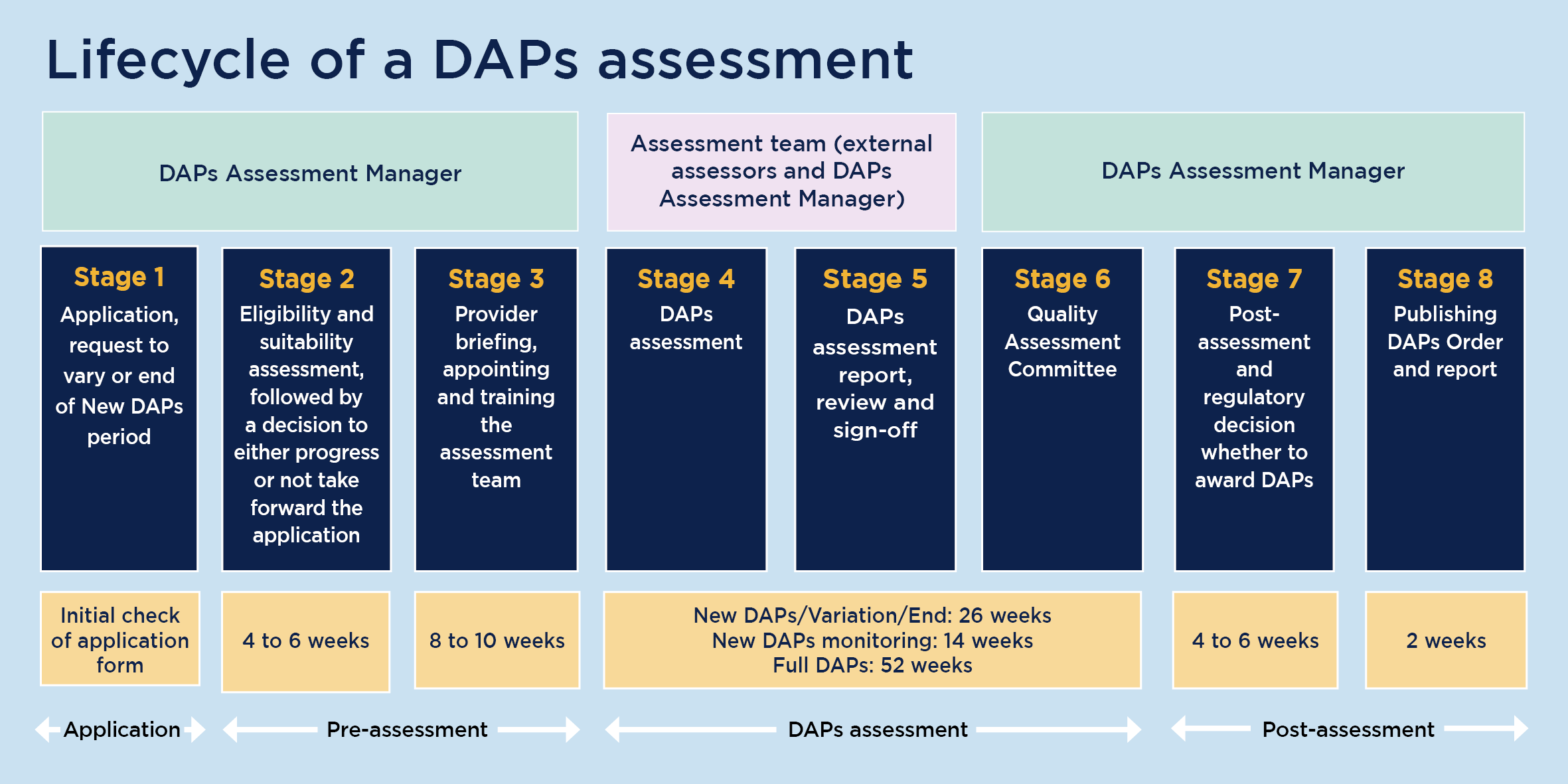
We will check that you have submitted a correct application with all the relevant documents we require.
The application will enter the DAPs pipeline for scheduling. We will typically hold an initial provider meeting once an application has been received, which will summarise the DAPs application and assessment process, and provide an opportunity for the provider to ask questions.
We will assess your eligibility and suitability for degree awarding powers against our guidance on applying for degree awarding powers or a variation to these powers, and the regulatory framework.
This will assess whether you:
- meet the eligibility requirements
- are suitable for degree awarding powers, as set out in paragraphs 228 and 229 of the regulatory framework. This states that:
- We will consider our existing risk assessment for the provider to determine the provider’s suitability for DAPs. This includes considering its financial viability and sustainability, and its management and governance arrangements to ensure that the provider has the necessary resources to set and maintain academic standards.
- For New DAPs, if a provider is subject to one or more specific ongoing conditions of registration – for example, because they have been imposed to mitigate increased risk of a breach of an ongoing condition relating to quality, standards, financial viability and sustainability, or management or governance – an application for New DAPs may be less likely to succeed.
- have a suitable student protection plan in place, which has been agreed by the OfS (this only applies if you are applying for New DAPs).
Once we have completed the eligibility and suitability assessment, we will decide whether you can proceed to the DAPs assessment. We will write to you, explaining next steps and to arrange a provider briefing.
This briefing will cover the assessment process in more detail, and gives you a chance to ask questions. During this stage we will also formally schedule, appoint and train an assessment team, comprised of expert academic assessors.
The assessment formally begins when you submit your self-assessment, New DAPs plan (where relevant), and supporting evidence. The assessment team will meet for the first time, at the same time as this submission.
This stage will also include:
- desk-based assessment
- provider visit(s) and/or observations (if required)
- further evidence requests (if required)
- report drafting.
Towards the end of the assessment, the assessment team compiles an assessment report.
This goes through at least one round of internal review before we share it with you and prepare it for consideration by the Quality Assessment Committee (QAC).
The report goes to the QAC, which provides advice to the OfS on the quality and standards of your provider's higher education relating to the authorisation, variation or revocation of degree awarding powers.
We decide whether to authorise DAPs based on the assessment report, QAC advice, and wider regulatory intelligence we hold. We will inform you about the decision.
We will normally publish the DAPs assessment report on our website. Where an authorisation is made, a DAPs order will be published on the UK legislation website as a statutory instrument.
How long does it take?
We currently estimate that we will start work on new applications approximately 12 months after we receive the application.
We previously paused our assessment of DAPs applications from December 2024 until August 2025. This was to refocus our resources to support our work in response to the financial challenges affecting higher education providers in England.
As a priority, we are now assessing applications that were paused and providers that hold time-limited DAPs.
The overall timeframe of the DAPs application and assessment process (stages 2 to 8) varies by the type of assessment:
|
Type of assessment |
Overall timeframe (stages 2 to 8) |
Timeframe of DAPs assessment (stages 4 to 6) |
|
Variation |
52 weeks (1 year) |
26 weeks (6 months) |
|
Full DAPs |
78 weeks (18 months) |
52 weeks (1 year) |
|
New DAPs |
52 weeks (1 year) |
26 weeks (6 months) |
|
New DAPs monitoring |
32 weeks |
14 weeks* |
|
New DAPs End Assessment |
52 weeks (1 year) |
26 weeks (6 months) |
*Stages 1, 6 and 8 do not apply to New DAPs monitoring.
These timelines are indicative and will vary depending on the circumstances of the application. Some complex applications are likely to take longer, which means that we cannot give a precise timescale for the assessment.
The process may take longer if assessors:
- uncover issues with evidence
- need to request further evidence at multiple points or seek further clarification
- reach negative judgements.
Describe your experience of using this website