
Financial pressures and financial sustainability
What we require providers to do
Higher education providers that are registered with us must be financially viable and sustainable. To ensure this, we require regular information about their financial performance and position. This page also lists some measures that providers in financial difficulty should take.
1. Submit financial returns
Providers must submit timely information to us about their latest financial performance and position.
We gather this information through:
- annual and interim financial returns, which include data about their recent and forecast financial performance and position
- discussions with providers and additional requests for information throughout the year as required.
We use this data, along with other sources such as reportable events or notifications, to understand individual providers’ finances and to examine the financial health of the higher education sector as a whole.
2. Self-assess using our risk assessment framework
Our financial viability and sustainability risk assessment framework explains how we evaluate risk and apply regulatory judgement, which informs how we engage with providers and the expectations we set.
Providers should use the framework as a tool to assess their financial resilience, including:
- to consider their exposure to financial risks
- to identify potential vulnerabilities in their financial position
- to inform decisions about where mitigations may be needed or oversight needs to be strengthened.
The framework sets out how we assess an institution’s financial risk, which institutions should refer to as they manage their financial position. We use the framework in our conversations with institutions to establish a shared understanding of risks and the action that may be needed to address these.
3. Report financial risks
Institutions are required to report material adverse events to us, for example if there is a significant financial downturn or if they forecast low levels of cash.
Examples of a significant financial downturn include:
- a provider not being able to pay its creditors
- an external auditor concluding that the provider may not be a going concern.
A forecast low level of cash could mean a likely drop in the provider’s liquidity to below 30 days’ average expenditure unless this is the provider’s normal cash management policy or it is mitigated through an agreed revolving credit facility, overdraft or other financing.
The report to the OfS should include updated financial and student number forecast tables, a commentary to explain the changes and any mitigating actions a provider is taking to address the changes (if relevant).
We will continue to ask universities and colleges facing large or complex financial risks to submit information about their cashflow more regularly.
4. Engage with the OfS
Providers in financial difficulty should let us know as soon as possible, so we can work effectively together from an early stage to protect the interests of students.
We will then engage with a provider to understand its circumstances in more detail.
Informed by our financial analysis and these discussions, we may increase our monitoring and engagement, which could include requiring additional information or taking further regulatory action where necessary to protect students’ interests.
5. Strengthen governance
We typically see that providers with lower financial risk demonstrate strong governance and oversight, with credible financial planning and effective risk management and assurance.
The pressures that universities face mean that they may need to consider difficult decisions such as strategic and operational change or cost reduction programmes.
Boards should consider the impact of such measures on key control functions, such as risk management, internal audit and governance support.
Strong governance that provides scrutiny and challenge is important in this situation. Governing bodies need to have members with the right skills and experience.
Institutions and governing bodies should base their plans on more prudent forecasts to secure their long-term financial health and ensure they can continue to deliver a high quality education for students.
They should be familiar with the OfS’s role and responsibilities as a regulator, as well as their own as directors and trustees, and conduct regular reviews of their effectiveness.
They should also respond to challenges in good time rather than leaving a response to a late stage.
Some boards may wish to consider reviewing their size and composition and push their institution to carry out self-assessment against our financial viability and sustainability risk assessment framework, stress testing and scenario planning.
6. Take responsibility for partnership arrangements
Providers involved in validation and subcontractual partnerships should ensure that risks to students are identified, assessed and managed throughout the arrangement. This includes understanding the potential impact of financial or operational difficulties affecting any partner and taking timely action where risks emerge.
We expect validators to take primary responsibility for identifying, monitoring and managing risks to students arising from any risk of institutional closure.
In subcontractual arrangements, lead providers remain responsible for overseeing risks and protecting students if a delivery partner is at risk of closure or exits the market.
Lead providers and validators should maintain effective oversight and have clear, workable contingency plans in place for all partnerships for how and where students may continue their studies if that partner closes.
7. Engage with lenders
Universities should also have a strong and proactive relationship with external partners, such as funders, lenders or other non-academic partners.
Providers at higher risk should consider their obligations to share relevant information with lenders and other financial stakeholders. Providers are responsible for deciding the extent of disclosure, in line with their circumstances and contractual obligations.
They may want to hold early conversations with banks or other lenders about renegotiating any borrowing.
Some banks may be more risk averse than previously so universities should plan for different eventualities.
If a university needs to discuss lending or, for example, a potential covenant breach, they should be aware that this could take longer under current financial pressures.
Universities should make sure that their financial advisers can meet their requirements and have relevant experience of the higher education sector.
8. Protect students and meet other regulatory requirements
Providers should consider the effect that any plans they have to address financial difficulties will have on different students and courses.
They should minimise any disruption. They should also consult with students and make sure students receive clear, accurate and timely information about any changes.
Providers should also make sure that students receive what they were promised when they applied to study.
Where this is not delivered, they take prompt action to put things right and provide appropriate redress to students.
Registered providers must also continue to meet all our regulatory requirements. Anything they do to make sure they are financial sustainable must ensure they also, for example:
- continue to offer a high quality experience for students
- treat students fairly
- maintain the work they have agreed to address equality of opportunity.
Last updated 23 July 2026 + show all updates
23 July 2026 - Minor updates alongside publication of our financial viability and sustainability risk assessment framework, including new section on self-assessment.
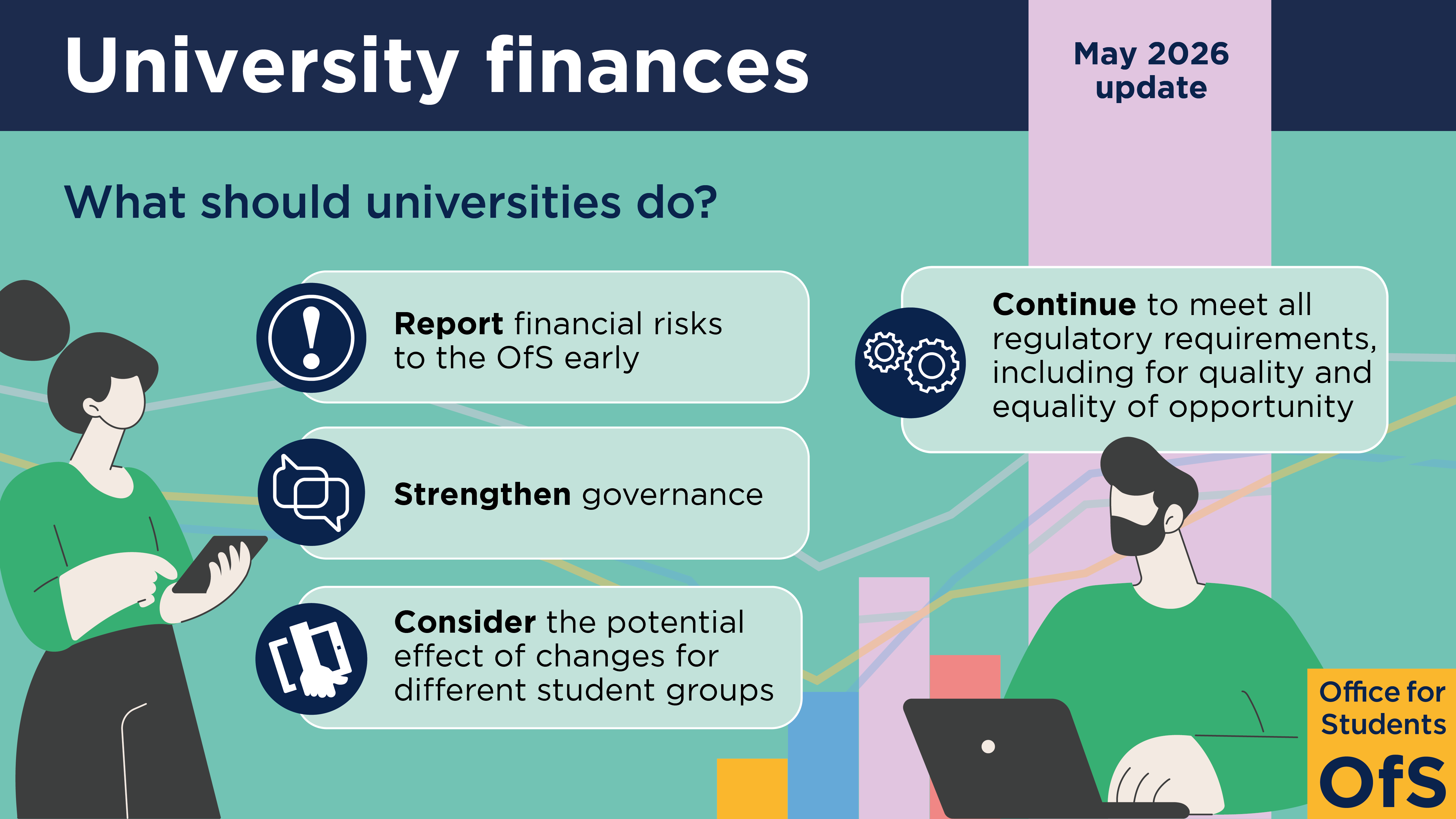
14 May 2026 - We have updated the infographic in line with our May 2026 financial sustainability publication.
20 November 2025 - We have updated list of activities for providers to do.
16 January 2025 - Content refresh following the release of our latest blog post on what the OfS is doing to help universities and colleges ensure their long-term financial sustainability
Describe your experience of using this website