
Philippa Pickford, our Director of Regulation, spoke at the Association of Colleges conference on 5 March 2026. Here is a transcript of her keynote speech, ‘OfS priorities and the regulation of colleges in an evolving landscape’.
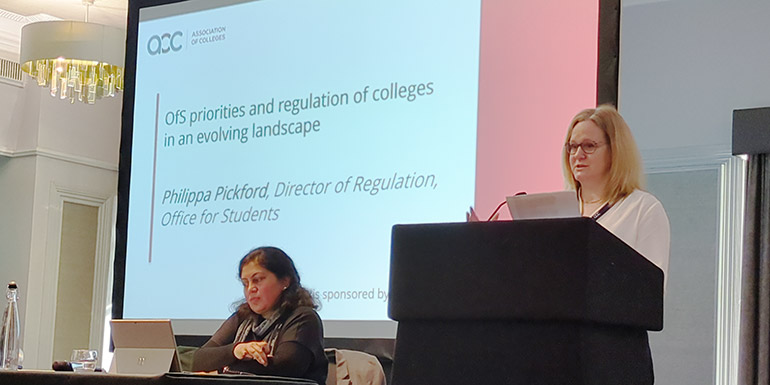
Good morning everyone. And thank you for your warm welcome Arti and for the opportunity to come and speak to you all today.
When I received the invitation, I reflected on this being an audience that I haven’t spoken to before. I know John Blake joined you last year, and Susan the year before that, and it is remarkable how much has changed since they spoke to you.
I am talking to you today from my perspective as Director of Regulation. I’ll talk about how I see the evolving national landscape as it relates to further education colleges, and how the OfS as a regulator is changing within this context. I’ll then talk about the importance of ensuring our regulation is targeted, and how we are doing this in our current policy work. And finally, I’d like to talk a bit about the implementation of the Lifelong Learning Entitlement, and some of the opportunities this will present for all of us.
Impact and successes of colleges
Starting then with the size and shape of further education (FE) college education. In terms of the big picture, 213 colleges provide education for over 1.6 million students – a huge number – and these 1.6 million students are supported by over 130,000 staff. So colleges are often a significant local employer.
If we think about FE colleges within the broader higher education sector. Over two thirds of colleges – that’s 145 of England’s 213 colleges – are registered with the OfS, and nearly a third of OfS-registered providers are FE colleges – that’s 145 of the 427 on our register - so a very established part of the national higher education landscape.
You also deliver diverse higher education provision – foundation degrees, HNCs and HNDs, higher technical qualifications, higher and degree-level apprenticeships, adult education, modular learning – as well as undergraduate and in some cases postgraduate degrees. Your student demographic is also diverse, with over a third of all disadvantaged young people progressing into higher education having studied at colleges, and mature students being a very significant group taking a higher education qualification at FE colleges.
These are all things that I have observed when I’ve visited FE colleges over the past two and a half years. I’ve seen first-hand many examples of high-quality student experience; the depth of commitment and social purpose amongst academic and support staff; and the significant contribution to local employers and communities that colleges make and engaged, inspiring students. I will talk more about this when I speak to the white paper in a moment.
I was also pleased to see real successes for colleges in the recent OfS capital funding round, in which bids were assessed based on the needs of local employers and regional economies. Just to pull out one, Yeovil College was awarded over £2 million for a major redevelopment of its engineering building to support higher level skills in advanced manufacturing and defence engineering – new facilities which will be operational for higher education learners by September 2026. That’s just one example, but there are many.
Evolving national picture and skills reform
Turning to the post-16 education and skills white paper, this has set out a national mission focused on a reformed skills system that drives growth, supports lifelong learning and enables clearer progression routes for students.
In particular, the white paper highlights the need for stronger alignment between higher education provision and the regional and national skills mix – envisaging closer connections between higher and further education, and between higher education providers, employers and regional bodies. It is also clear about the need for expansion of level 4/5 and technical pathways, as well as introducing the target of two thirds of young people entering higher level education or training by 2040, with a clear focus on high quality, resilience and ensuring equality of opportunity for all prospective students.
When looking at this vision, it is clear that FE colleges will be an important part of this shift and are already making strides in this direction. When it comes to matching skills mix with demand, colleges are typically rooted in their local areas and economies, equipping students for work based on regional skills needs. On my visits to colleges, I have seen great examples of how local skills needs are taken into account, with courses designed and delivered to match. I’ve also seen how colleges work with local employers to provide workshops, placements and competitions to maximise student experience and equip them for the workplace.
When it comes to Level 4 and Level 5 provision, FE colleges offer a variety of flexible, vocational and technical pathways to those wanting to upskill, often leading to strong economic returns for students. So you are already at the forefront of this change.
And when it comes to access for all, FE colleges are essential for widening participation, particularly for adult learners and disadvantaged students. When speaking to students at FE colleges I have heard again and again stories of FE colleges providing a route to education for students often later in life or where students have struggled to thrive in more traditional higher education routes.
When looking at the white paper, it is clear to me that FE colleges will continue to have a growing and crucial role in delivering HE provision and meeting the government’s vision. I am very much looking forward to listening to the panel discussion on this topic later this morning.
Our strategy for 2025-2030 and what this means for FE colleges
The OfS is also adapting in this evolving national landscape. I am sure you will all be familiar with the OfS strategy which we published in November, so I won’t talk through that in detail.
This strategy aligns to our overall mission, to ensure that students from all backgrounds benefit from high quality education, delivered by a diverse and sustainable sector that continues to improve. And in terms of what we will do, our work is structured around three strategic goals: quality; student experience and support; and sector resilience, with equality of opportunity interwoven throughout.
But this new strategy is as much about how we regulate – our attitudes – than it is the what. Given the level of change happening in higher education the details of what we do will almost definitely change during the strategy period – so this strategy aims to provide clarity around how we will respond and act to increase certainty and predictability for the sector. The attitudes will therefore be embedded in how we work and include: being ambitious for all students from all backgrounds; collaborative in pursuit of our priorities; vigilant about safeguarding public and student money; and vocal that higher education is a force for good.
You’ll hopefully be starting to see this change already. We’re increasingly talking to stakeholders earlier about key policy areas, such as through our engagement prior to launching consultations. We’ve also recently launched our provider panel, a committee of the OfS board which gives advice and constructive challenge on our policy. This panel met for the first time recently, and its views have already informed our discussions with the OfS board in a number of areas.
But that’s not all – our attitudes also embody how we will improve our engagement with colleges specifically. I recognise that our interactions with you must feel more relevant and tailored, underpinned by clear communication channels. We’ve already made some changes in this respect. We now have a dedicated policy lead for FE colleges, Alastair Wilson, who is attending the conference today and whom many of you will already know. And we have also developed FE-specific communication channels such as a new mailbox and landing page on our website.
We’re keen to continue to receive feedback on how this is all working from your perspective, so please keep talking to our teams. And later in the spring, we’ll publish the results of our first provider survey, in which over 200 accountable officers have told us about their experience of being regulated by the OfS. Positive early results indicate we’re improving, as well as giving us some areas to focus on as we continue to develop our approach.
Importance of targeted regulation
But I want to turn now to how we are ensuring our regulation is targeted where appropriate. We recognise that complying with regulation can cause costs for providers and we are keen to ensure that our regulation – which is important to ensure that the interests of students are protected – balances this, and, for FE colleges in particular, that our regulation takes account of other regulatory frameworks that apply. We actively consider these issues both in our policy work and at system level.
There are live examples where we are proposing to ensure our regulation is appropriately targeted. As you know we are currently consulting on proposals to simplify how we regulate FE colleges by disapplying a number of our initial and ongoing conditions of registration. This recognises that colleges are regulated both by the Department for Education and the OfS. The proposals will primarily apply to FE colleges without degree awarding powers and to colleges newly seeking registration with the OfS. We are now considering the responses and expect the outcome to be published in early Summer 2026.
We are thinking carefully about how new regulation should apply to FE colleges. For example, we will shortly publish the outcomes of a consultation on a new condition of registration which proposes to strengthen oversight where higher education is delivered through sub-contractual arrangements. We proposed that the requirements in this condition would not apply to subcontractual arrangements where the delivery partner was an further education college as these are not the types of subcontractual arrangements where we have seen risks arise.
And finally we are still carefully considering how our proposals relating to the future of the quality system, including the Teaching Excellence Framework (TEF), will impact on FE colleges. In principle, we think that all providers delivering higher education should be subject to regular quality assessment, to ensure that all students are assured of a high quality experience. However, we’re also aware that for smaller providers the data underpinning this can be patchy or complex, and the effort of producing submissions can fall on busy individuals or small teams.
As a result, we put forward some proposals about how we might take account of these issues, and asked for suggestions on how we could enable smaller providers to take part effectively. We’re currently working our way through responses, and are looking carefully at suggestions such as tailored guidance for different types of providers, structured templates, and simpler presentation of data. We expect to publish more detailed proposals on the TEF guidance, assessment methods, and data in the Autumn, and I encourage you to continue to engage with us on this in the meantime.
Reflections on the LLE
To finish off today, I wanted to share my reflections about another policy area we are thinking carefully about – the implementation of the Lifelong Learning Entitlement (LLE).
The opportunities of the LLE are considerable. At an individual level, this is going to enable those between the ages of 18 and 60 to access funding flexibly for full courses and modules to learn, upskill and retrain – brilliant new routes for participation in higher education. Then at system level, the LLE will enable a more focused and deliberately planned sector, leading to a shift away from full degree programmes, and potential changes in the market to respond to priority areas. For these reasons, I think provision delivered through the LLE will play to the strengths of FE colleges.
With any new form of provision like this, it is of course important that we remain focused on quality and value for money as we start to roll out LLE – and I am sure that this is something you are all giving thought to. So what does this all mean for how we regulate providers. Well, to begin with our regulation of LLE will feel very similar to the way we regulate now. When we consulted on our quality conditions, we knew that LLE was coming and we were careful to use definitions of quality that would apply equally to an individual module and a whole course.
Once it has launched in January 2027, LLE-funded higher education will be subject to our usual monitoring and risk-based approach to regulation. Providers will need to continue to meet our conditions of registration which require them to deliver a high quality academic experience. However, we will obviously be monitoring this provision more closely given that it is new, and may adjust our approach if we see risks develop.
The one key difference to our regulation will be in how we measure positive outcomes from modules. Our current condition B3 requires positive outcomes for students and uses indicators that can’t be applied to the study of modules. So we will be developing new indicators and will begin to collect modular completion data from the 2027-28 academic year to inform the development of a completion indicator and an appropriate threshold. We’ll work with the sector to explore the development of this measure for students, and will of course consult on our approach. Ahead of any threshold being in place, we will be thinking about how best to protect students and public money from any very obvious poor performance – we’ve seen some examples in our work of courses where only a few students have completed and we’d want to be able to intervene in these circumstances. We’re therefore likely to include something in our quality consultation in the autumn about providers meeting the principle of delivering good outcomes in module delivery. Further information about these timelines will be published on our website shortly.
Well, hopefully the last 20 minutes has given you a good sense of our current thinking and next steps in a number of areas – it has certainly been a real whistlestop tour! I’ll stop there for now, and look forward to answering any questions you might have.
Comments
Report this comment
Are you sure you wish to report this comment?