Proposals for a revised approach to assessing and rating quality
Published 22 October 2026
Proposal 17: Assessment approach
Stage one decisions
- We will assess student experience on the basis of provider submissions, an expanded set of NSS-based indicators, and additional evidence from students.
- We will assess student outcomes on the basis of the continuation and completion indicators, and an expanded set of post-study indicators, taking additional context into account.
- We will embed equality of opportunity in assessments, by considering the extent to which the quality of the student experience and student outcomes are consistent for all groups of students.
What we are proposing now
- We propose how assessors would weigh evidence, reach judgements and determine aspect ratings or outcomes.
- We also propose how assessors would consider consistency across student groups, subjects and areas of provision when awarding ratings.
Why we are proposing this
- This approach is intended to ensure expert judgement can be applied within a framework that is evidence-based, transparent and consistent.
Key points of this proposal
- Assessors would reach and record a judgement for each criterion, weighing up relevant evidence.
- For providers not applying for TEF ratings, assessors would determine whether the evidence provides sufficient assurance that the relevant quality conditions are met and award a Satisfactory or Unsatisfactory outcome for each aspect.
- For TEF ratings, judgements about the criteria would take account of consistency across student groups, subjects and areas of provision.
- As an initial ‘rule of thumb’, at least 80 per cent of students experiencing a similar level of quality would be considered broadly consistent.
- Lower quality or outcomes for substantial areas of provision or groups of students would be likely to limit the judgement.
- The data dashboards would help to identify areas of provision or groups of students with lower quality or outcomes, that may potentially limit the judgement.
- Judgements about the student experience criteria would normally give half the weight to the NSS-based indicators and the other half to additional evidence of quality in the submissions.
- For providers undergoing an enhanced assessment, assessors would also consider the additional evidence, including the visit to the provider.
- Judgements about the student outcomes criteria would initially consider the indicators, and then consider relevant and compelling contextual evidence submitted by the provider.
- In reaching a judgement on the post-study criterion, assessors would consider all the available measures and normally place more weight on the most positive measure.
- Judgements about the rating for an aspect would consider the overall pattern of judgements across the criteria and consistency across student groups, subjects and areas of provision.
- A rating of Requires improvement or an outcome of Unsatisfactory would normally reflect one or more criteria being judged as unsatisfactory.
Explanation
Determining whether minimum quality requirements are met
- Under our proposed quality assessment system, assessors would consider whether the available evidence provides sufficient assurance that the provider complies with the relevant quality conditions.
- This assessment would be based on the available evidence as a whole, for each aspect. The assessment would draw on:
- published indicators
- provider submissions
- evidence gathered through enhanced assessments, where applicable
- other relevant evidence available to us.
- Assessors would consider whether the evidence demonstrates compliance with:
- conditions B1, B2 and B4 for student experience
- condition B3 for student outcomes.
- For student experience, assessors would consider whether the evidence provides assurance in relation to the six criteria set out in Proposal 7. These criteria have been developed so that the level of quality defined as ‘satisfactory’ aligns with meeting the requirements of conditions B1, B2 and B4. The six criteria collectively cover consideration of the following:
- For condition B1, whether students receive a satisfactory quality academic experience. This would include consideration of whether courses:
- Are up to date.
- Provide educational challenge.
- Are coherent.
- Are effectively delivered.
- Require students to develop relevant skills.
- For condition B2, whether students receive the resources, support and engagement necessary to succeed in and beyond higher education. This would include consideration of whether:
- Students have access to appropriate learning resources, including physical and digital learning resources.
- Teaching is delivered by a sufficient number of appropriately qualified and experienced staff.
- Students receive effective academic support throughout their studies.
- Students receive effective careers support.
- There are effective arrangements for student engagement.
- The provider identifies and responds appropriately to the needs of different cohorts of students.
- The provider takes all reasonable steps to ensure students receive the resources, support and engagement necessary to succeed.
- For condition B4, whether:
- Students are assessed effectively.
- Assessments are valid and reliable.
- Academic regulations are designed and operated to ensure awards are credible.
- Arrangements for assessing technical proficiency in the English language are appropriate.
- Academic misconduct is appropriately managed.
- Awards granted to students are credible and remain credible over time.
- For condition B3, assessors would consider any student outcome indicators of concern that were identified in the initial risk assessment. This would include consideration of:
- continuation
- completion
- post-study outcomes.
- Assessors would consider whether relevant contextual evidence and any other relevant information available to them justifies these outcomes. The assessment and evidence would be the same as that described in Section 3 (Student outcomes).
- Assessors would consider all relevant evidence for each aspect in the round and determine whether it provides sufficient assurance that the requirements of the relevant conditions are being met.
- After reaching judgements about each of the criteria, assessors would determine an overall outcome for each aspect. Assessors would weigh up the judgements across the criteria, and the extent to which these reflect consistent quality or outcomes.
- For student experience, we propose the individual criteria would be equally weighted.
- For student outcomes, we propose an equal weighting between study outcomes (that is, continuation and completion) and post-study outcomes. This reflects the importance to students of succeeding in and beyond their studies.
- Where assessors judge the criteria to be satisfactory and the requirements in the conditions are therefore met, the outcome would be Satisfactory.
- Where assessors judge one or more criteria to be unsatisfactory, the outcome for that aspect would be Unsatisfactory.
TEF assessments
- Figure 3 explains the key elements of our proposed assessment approach to determine TEF ratings. We expand on this in Part 8 of the draft guidance to give respondents a detailed understanding of how this approach would be applied.
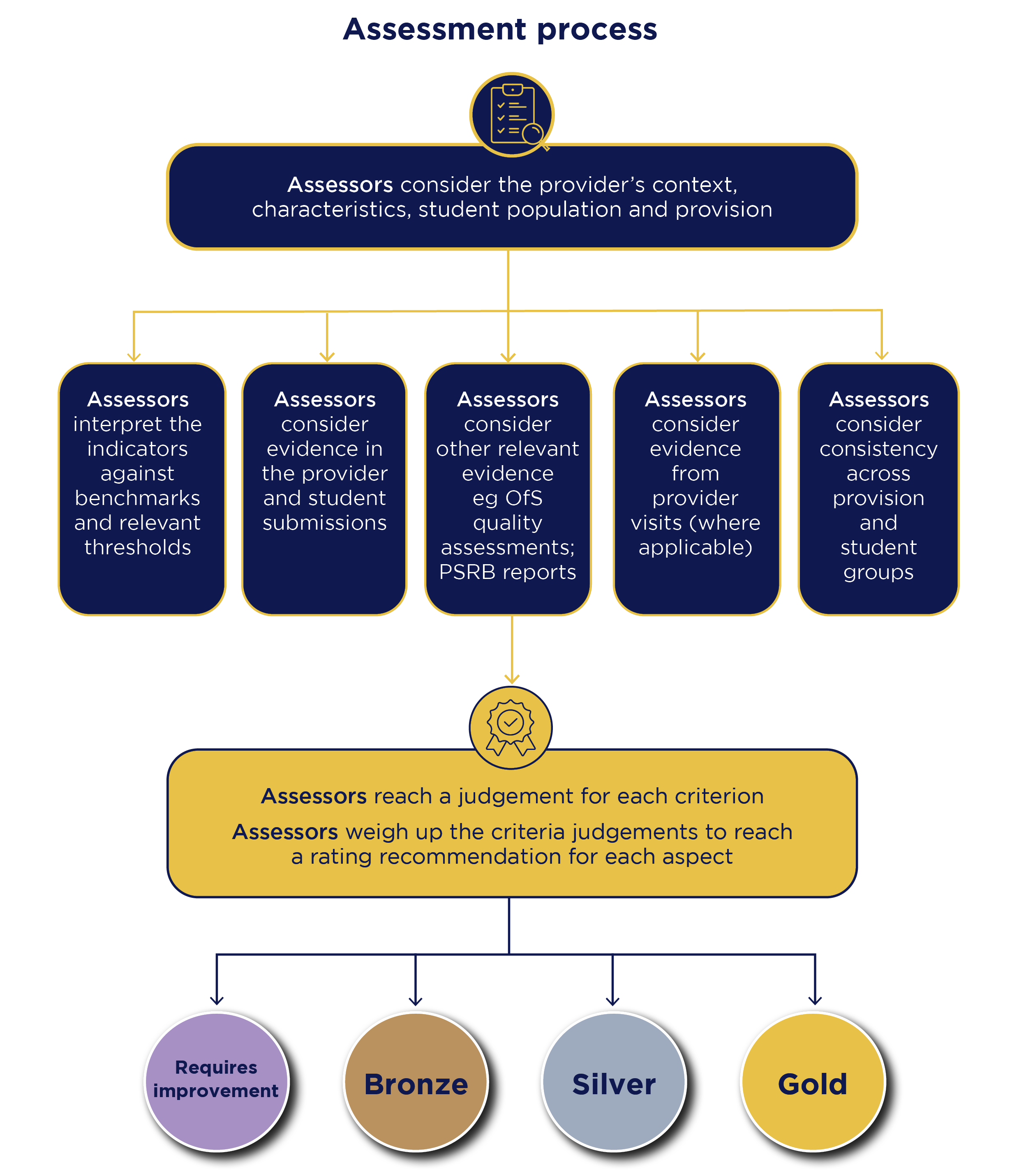
- Assessors would begin by reviewing the ‘size and shape’ data and the provider’s contextual statement, to understand the provider’s broad context, including its characteristics, student population and mix of provision.
Judging the criteria
- Assessors would then consider each aspect being rated, by considering the evidence in relation to each of the criteria for the aspect. We propose that to ensure a consistent approach to the assessment, and to provide transparency for providers and useful information for students, assessors would reach and record a judgement for each criterion. They would judge each criterion as one of the following:
- outstanding
- high quality
- satisfactory.
- To judge each criterion, assessors would weigh up all the relevant evidence.
- Assessors would initially interpret a provider’s indicators against its individual benchmarks. For the continuation and completion indicators, they would also take account of absolute levels of performance, against relevant absolute thresholds. This interpretation would provide an initial indication of different levels of quality, against the relevant criteria. They would consider the extent of statistical uncertainty in the indicator data and give greater weight to stronger statistical evidence. Where statistical uncertainty means that an indicator could reasonably support more than one interpretation, they would take this into account when forming their judgement.
Judging the student experience criteria
- For the student experience aspect, criterion judgements would reflect a triangulation of indicator evidence with evidence from the provider and student submissions, enhanced evidence gathering (if applicable) and other relevant evidence from OfS quality assessments or Ofsted assessments of apprenticeships. Assessors would normally give half the weight to the relevant NSS-based indicators, taking account of contextual information in the provider submission that may affect interpretation of the data, and the remainder of the weight to the other evidence. However, this would depend on the strength and relevance of the various sources of evidence.
- For example, they would give less weight to:
- Information in a provider submission that describes an initiative without providing evidence of its impact on the student experience.
- Views stated in the student submission without indicating how those views were gathered from a range of students.
- An Ofsted assessment of apprenticeships carried out very early in the period being assessed, or where apprenticeship provision represents only a small proportion of a provider’s overall provision.
- For enhanced assessments where risks have been identified, assessors would normally conduct a visit to the provider and gather evidence focused on understanding potential concerns about particular criteria. Evidence gathered in the enhanced assessment would be likely to carry significant weight when judging those criteria.
- Where evidence sources conflict, assessors would use expert judgement, giving greater weight to evidence that is more robust, representative or directly relevant to the criterion being considered.
- Where no student submission is available, assessors would consider why the students decided not to make a submission. Where the decision not to participate is due to barriers that the provider could reasonably have addressed, such as a lack of support, access to information or capacity, assessors may consider this indicates a lack of effective student engagement, when reaching a judgement on the student engagement criterion. If the decision not to take part is for reasons unconnected to capacity or support, assessors would treat the lack of a student submission neutrally and would rely on the other available sources of evidence.
- We consider this approach to weighting the sources of evidence for the student experience gives due weight to students’ views about the quality of their experience, while avoiding overreliance on the NSS data alone. It recognises that the criteria for the student experience extend beyond the themes covered by the NSS and that providers themselves have a range of approaches to monitor and evaluate quality that generate evidence that would be relevant to the assessment.
Judging the student outcomes criteria
- For the student outcomes criteria, assessors would form an initial judgement based on the available indicators, taking account of both benchmarked and, for continuation and completion, absolute performance.
- They would then consider any relevant contextual information in the provider submission to determine whether the initial judgement should be adjusted, including in cases where there are indicators identified as being of concern. Where necessary, they may request further information or clarification about the contextual information or the effect of taking certain factors into account (for example, the effect of removing certain courses that are no longer running from the data). They may also request that OfS data specialists verify or calculate these effects.
- We have considered whether the assessors should normally give greater weight to more recent years of data. We propose that they would consider any trends in performance over the four years of data, along with any supporting evidence in the submission, and whether these demonstrate evidence of either sustained improvement or a sustained decline in rates of student success in more recent years. Sustained improvement could result in a more positive judgement about an indicator and sustained decline in a less positive judgement. We intend this to ensure that judgements are fair and reflect the current student experience and outcomes as far as possible.
- When judging the post-study criterion, assessors would take account of the basket of post-study measures, and relevant contextual information in the provider submission. As set out in Proposal 13, they would normally give greater weight to the most positive of the three post-study measures. We set out this approach in more detail in Part 4 of the draft guidance.
Consideration of consistency
- In Proposal 7 and Proposal 13 we set out that higher ratings would require consistently high quality or outstanding quality, and that significant weaknesses in particular subjects, modes of study or groups of students would constrain the overall rating awarded. We propose that assessors should consider consistency when judging each criterion, as well as when determining the rating for the aspect.
- Initially, when judging each criterion, the assessors would consider whether the indicators suggest that quality or outcomes are delivered consistently across students and provision, including study modes and subcontractual provision and the ‘splits’ for different student groups, subjects and courses types.
Proposed approach to consideration of consistency
We propose that assessors would use an indicative rule of thumb when considering whether quality or outcomes are broadly consistent across a provider. Normally, this would be at least 80 per cent of students experiencing a similar level of quality or outcomes. Where the data indicates that at least 20 per cent of students experience lower quality or poorer outcomes, and this is not adequately justified or addressed in the submission, this would be likely to limit the judgement reached.
TEF ratings apply at a provider rather than subject level and we consider that a Silver or Gold rating should indicate that students can reasonably expect high or outstanding quality across all provision, not only in its strongest areas. We consider that 20 per cent is a significant proportion of the student population and do not think a higher rating would normally be appropriate if that proportion of students experiences lower quality or outcomes.
At the same time, we recognise that there will be some variation across subjects, modes of study, partnerships and student groups. The proposed approach would allow providers to achieve a higher rating despite some weaker areas, provided these are limited in scale and do not fall below minimum quality requirements
We propose that 80 per cent would be appropriate, as this reflects a substantial majority of students experiencing a similar level of quality or outcomes, while ensuring that providers are held accountable for significant areas of weaker performance. We consider that if the percentage is too high this would not adequately recognise variation and would have the likely effect of preventing many providers from achieving higher ratings even when the large majority of their students may have an outstanding experience or outcomes.
Silver and Gold ratings are intended to indicate that high or outstanding quality is delivered consistently. We therefore think it is reasonable that providers should need to demonstrate that a large majority of their students experience that level of quality before such a rating can be awarded.
We also think a lower percentage would not sufficiently incentivise providers to ensure high quality across their range of provision or student groups, as they would be able to achieve a high rating despite lower quality or outcomes for substantial areas of provision or student groups.
We think that having an indicative rule of thumb would provide transparency for providers about how consistency would be considered, help them to identify areas to address in their submissions, and support consistency in judgements.
We would though be interested in views on whether a different percentage would be more appropriate.
We propose that initial rule of thumb would not be applied mechanically. Assessors would also consider the scale and nature of any variation, the level of performance concerned, and the provider’s explanation.
Assessors would consider lower quality or outcomes for disadvantaged student groups that may be fewer than 20 per cent of students. This would include disabled students, students from the lowest Index of Multiple Deprivation quintiles and students entitled to free school meals (FSM). This is because the opportunities to succeed in higher education for these particular student groups may be impacted by a range of sector-wide risks, as set out in our Equality of Opportunity Risk Register. In addition, these groups often represent less than 20 per cent of a provider’s total undergraduate population.
Assessors would consider whether lower quality or outcomes for any of these groups should limit the judgement reached. We are proposing this approach to ensure that the scheme incentivises improvement for all students and particularly those where sector-level performance is below the level of that for other groups. This reflects our commitment to equality of opportunity and recognises that some groups of students may face sector-wide risks to their success in higher education.
In addition, assessors may also pay attention to smaller areas of provision or student groups where the indicator is substantially below benchmark or the minimum threshold, and may raise a concern about meeting minimum quality requirements.
If this proposal is implemented, we would also propose that the data dashboards would highlight particular ‘splits’ that providers and assessors may pay particular attention to. We propose two types of highlighting, to recognise that the rule of thumb would not be applied rigidly:
- Highlighting all splits representing at least 20 per cent of students that are at a level of performance below the overall indicator. All of these would be considered in the assessment as potentially limiting the judgement.
- Secondarily highlighting splits representing at least 10 per cent of students, that are at a level of performance below the overall indicator. These would be considered in the assessment as potentially limiting the judgement if they relate to certain disadvantaged student groups, or if the level of performance indicates a potential concern about meeting minimum quality requirements.
- Where the assessors find variable quality or outcomes across provision or student groups in relation to a particular criterion, they would state this alongside the overall judgement for the criterion. For example, ‘Academic support is of high quality overall. In some subjects it is outstanding.’
- In some instances, we anticipate there may be insufficient evidence to reach a single clear judgement on a criterion. We consider that the assessors should, where appropriate, have the option of making a mixed judgement where evidence supports this, or conclude that there is insufficient evidence to reach any judgement on a criterion. Mixed judgements would be taken into account alongside the overall pattern of criterion judgements and evidence when determining the aspect rating. Where there is insufficient evidence to reach a judgement on a criterion we would consider whether it would be appropriate to request further information from the provider, or to proceed with the assessment and determine the aspect rating based on the other criteria.
Rating the aspects
- After reaching criterion judgements, assessors would determine an overall rating for each aspect being assessed. Assessors would weigh up the judgements across the criteria, and the extent to which these reflect consistent quality or outcomes. Assessors would make a judgement about which published rating descriptor provides the best fit.
- For student experience, we propose the six criteria would be equally weighted.
- For student outcomes, we propose an equal weighting between study outcomes (that is, continuation and completion) and post-study outcomes. This reflects the importance to students of succeeding in and beyond their studies. We consider it appropriate that a rating of Gold, for example, should require both study and post-study outcomes to be outstanding.
- A rating of Requires improvement would reflect one or more substantial areas of unsatisfactory quality or outcomes. Assessors would consider how widespread or serious areas of unsatisfactory quality or outcomes are in deciding whether a rating of Requires improvement is appropriate. For example, they would normally reach a Requires improvement judgement for student outcomes where they had judged any one of the three student outcomes criteria as unsatisfactory. However, there may be cases where a provider could have one unsatisfactory student experience criterion judgement but assessors might consider the concerns not to be widespread or serious enough for a rating of Requires improvement.
- This approach is intended to support transparent and consistent assessment while allowing assessors to use expert judgement to reflect the overall pattern of evidence and the experience of different groups of students.
Further detail on the assessment methodology including interpretation of indicators, weighting of evidence, consistency, criterion judgements and aspect ratings, is set out in Part 8 and Annex D of the draft guidance.
Describe your experience of using this website