Proposals for a revised approach to assessing and rating quality
Published 22 October 2026
Proposal 1: The overall quality system
Stage one decisions
- We will modify the overall quality system to ensure that it is integrated, drives improvement across the sector, and provides a clear view of the quality delivered by different providers.
- All OfS-registered providers will be assessed in the future TEF, on a cyclical basis.
- We will assess and rate providers for ‘student experience’ and ‘student outcomes’.
- We will align the scope and ratings criteria for the student experience aspect with the requirements of conditions B1, B2 and the ‘effective assessment’ element of B4.
- We will integrate into the future TEF an assessment of whether a provider meets our minimum requirements for student outcomes (condition B3).
What we are proposing now
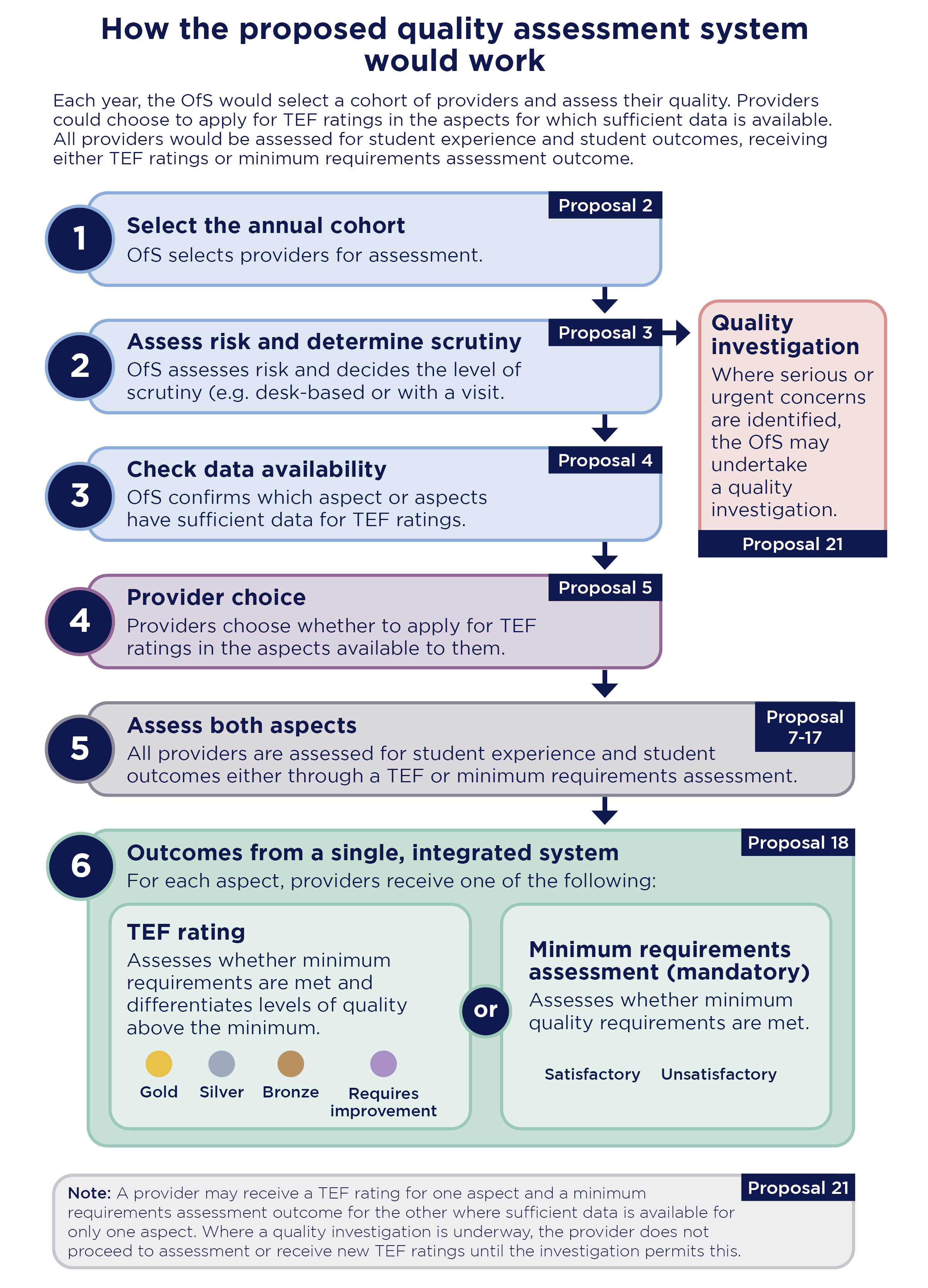
- We would assess all providers for quality on a cyclical basis. Each year we would choose a cohort of providers for assessment.
- The selected providers would be able apply for TEF ratings, which would show if the provider meets or exceeds our minimum quality requirements.
- Providers that do not apply for TEF ratings would only be assessed on whether they meet our minimum quality requirements.
- Where we identify concerns about compliance with quality conditions, the provider may instead be subject to a quality investigation.
Why we are proposing this
- These proposals would make sure that every registered provider has regular quality assessments.
- They would also allow providers to apply for a TEF rating and receive the benefits that come with it.
Key points of this proposal
- Each year we would select a cohort of providers for cyclical quality assessment.
- All providers would be assessed for meeting the minimum quality requirements (conditions B1, B2, B3 and B4).
- Providers would be able to choose whether to apply for TEF ratings as part of that assessment.
- Providers applying for TEF ratings would provide the additional evidence necessary to assess different levels of quality above the minimum, and support TEF ratings decisions.
- Providers that do not apply for TEF ratings would only receive outcomes indicating whether they meet minimum quality requirements.
- We would expect most registered providers to apply for TEF ratings.
- Providers without sufficient data for a TEF rating would still be assessed against minimum requirements.
- Some providers would instead undergo quality investigation, where we identify concerns about compliance.
Explanation
- Following stage one, we decided that all registered providers should participate in the TEF. Since then, we have developed the detailed design of the future quality system, including how it will interact with our ongoing risk monitoring and investigations of concerns about compliance. We have also reflected further on feedback in stage one and further engagement with sector representative groups about the mandatory nature of TEF. We are now proposing a different approach.
- We remain committed to the principle that all registered providers should be subject to cyclical assessment of quality. To meet that objective, we are now proposing to assess all providers selected for assessment each year through a common assessment framework. We would assess all providers against the minimum quality requirements set out in conditions B1, B2, B3 and B4. Providers with sufficient data available would be able to apply for TEF ratings. Providers that do not apply for TEF ratings, or that do not have sufficient data available, would receive a minimum requirements outcome.
- Through this approach we would assess all providers against the same minimum quality requirements, regardless of whether they apply for TEF ratings. All providers would need to submit evidence to show that they at least meet these requirements. Providers applying for TEF ratings would need to have sufficient data (as set out in Proposal 4), submit additional evidence and facilitate student submissions. This is to allow the assessment team to rate different levels of quality.
- Receiving TEF ratings would provide access to considerable benefits. Providers would only be able to access the inflationary uplift to tuition fees and any future uplifts to tuition fees established by the DfE through TEF ratings. We propose that providers could also only qualify for DAPs by achieving higher TEF ratings. We will shortly consult separately on how TEF ratings should affect eligibility for public grant funding. Providers that receive higher TEF ratings would also be subject to less frequent quality assessment.
- Providers that do not apply for TEF ratings would instead receive outcomes that indicate whether they have met the minimum requirements. We propose these providers would receive outcomes of Satisfactory or Unsatisfactory for student experience and student outcomes.
- We propose a common assessment approach with broadly equivalent outcomes. In Proposals 7 and 13 we propose a common set of assessment criteria based on the relevant B conditions. All providers would be assessed through the same framework. Providers applying for TEF would receive ratings, while other providers would receive a Satisfactory or Unsatisfactory outcome. As shown in Table 1, the TEF ratings and minimum requirement outcomes represent equivalent underlying levels of quality.
Table 1: Equivalence of assessment outcomes
| Minimum requirements outcome | TEF rating | Meaning |
|---|---|---|
|
Satisfactory |
Bronze |
Minimum requirements are met |
|
Unsatisfactory |
Requires improvement |
Minimum requirements are not met |
- This approach would ensure that we assess all providers against the same quality conditions, regardless of whether they seek a TEF rating. It would also avoid the need for separate assessment arrangements for providers that do not have sufficient data to support TEF ratings.
- Providers receiving TEF ratings would continue to receive any benefits, restrictions and consequences associated with those ratings.
- Providers that do not apply for TEF ratings would not receive Gold, Silver or Bronze ratings and therefore would not receive benefits that are specifically linked to TEF ratings, such as any fee limit arrangements determined by DfE.
- Providers should not be able to avoid the consequences of lower quality or poorer student outcomes by choosing not to apply for a TEF rating. We therefore propose that minimum requirement outcomes and TEF ratings showing broadly similar levels of quality should normally lead to similar regulatory consequences.
- For example, a provider with a Satisfactory outcome would normally face the same regulatory action and reassessment arrangements as a provider with a Bronze TEF rating. Similarly, a provider with an Unsatisfactory outcome would normally face broadly the same action and reassessment arrangements as a provider with a Requires improvement TEF rating.
- We think this approach is important. Providers that choose to apply for a TEF rating would access the benefits linked to that rating, but providers could not avoid the consequences of lower quality or poorer student outcomes by choosing not to apply.
- When we select a cohort of providers for assessment each year, providers would undergo an initial risk assessment, as set out in Proposal 3. The purpose of the risk assessment would be to identify potential concerns about compliance and determine whether a quality investigation would be more appropriate. This means that in some cases, a provider selected for assessment in a given year would be subject to a quality investigation instead of the standard assessment process.
Further information about how quality investigations relate to other quality assessment is set out in Proposal 21.
- As set out in Proposal 3, the risk assessment would also determine if additional evidence would be required as part of a provider’s assessment. We expect that most providers’ assessments would be desk-based (that is, based on data and submitted evidence). Where we identify risks through the initial risk assessment, we may gather additional evidence as part of the assessment, including through a visit to the provider, as set out in Proposal 11.
Throughout the document we use the following terms:
TEF assessments: where providers apply for ratings that show different levels of quality below, at or above the minimum requirements.
Minimum requirements assessment: where providers do not apply for TEF ratings and are assessed only on whether or not they meet minimum requirements.
Quality investigations: where we identify potential concerns about compliance and carry out an assessment focused on establishing whether the concerns are substantiated.
- Figure 1 below summarises the proposed system.
Describe your experience of using this website