
Suzanne Carrie spoke at the Universities UK conference on 26 February 2026. Here is a transcript of her keynote speech, 'Setting the direction: Risk and responsibility in student mental health'.
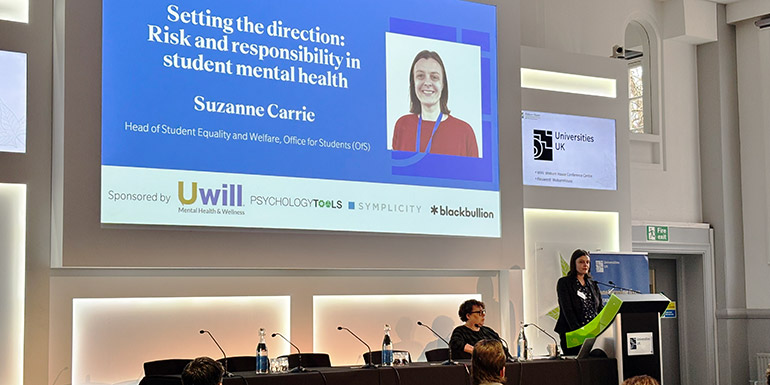
I’m pleased to have this opportunity to share key updates with UUK members and others about the OfS’s next steps on mental health and disability.
Since our inception, we have invested significant funding and resources into supporting universities and colleges to innovate and develop effective practice in relation to mental health. We’ve supported collaboration and the development of guidance, the University Mental Health Charter, and the Disabled Student Commitment. We also created a Disability in Higher Education Advisory Panel which has supported us in considering disabled students’ experiences and the impact of current approaches to driving improvement. I want to take the opportunity today to thank the members of the panel for their support over the past two years. Hearing from disabled students and from staff working with students has been so beneficial and the members’ thoughtful contributions have helped us to advance our thinking.
I wanted to begin today with an overview of what we see in the sector.
We have seen good practice develop across the sector and positive engagement with voluntary schemes and frameworks. This includes those published by UUK on strategic and whole university approaches to mental health as well as guidance on suicide prevention and information sharing. The Higher Education Mental Health Implementation Taskforce, of which we are an active member, has developed and published a suite of guidance and toolkits for institutions. These include a competency framework for student facing non-specialist staff, advice on compassionate communications, a national review of higher education student suicide deaths and guidance to support partnerships between higher education and the NHS.
However, despite this, we are deeply concerned by issues that students are facing, and the slow pace of change in some areas. We can see concerning outcomes and experiences for students who report mental health as a disability. We hear of the difficulties and barriers disabled students are having with complaints processes, as seen persistently in annual reports from the OIA. We know that information sharing is still a challenging area, between institutions and the health service, and also between institutions and families following a tragic event.
In 2024-25 more than 85,500 undergraduate full-time students in the UK had a mental health condition as a disability on their HESA student record, and mental health conditions are one of the two most commonly declared types of disability. We also know there is a high level of co-morbidity between mental health conditions and other disabilities and that not all students will tell their university or college about their mental health conditions. NHS estimates suggest that around one in four 17 to 19 year olds and one in five 20 to 25 year olds had a probable mental disorder in 2023.
When we look at academic outcomes for students by disability type, we can see that the picture is often complex. Although the continuation rate for students in the broad category of disability is slightly higher than those with no disability reported, students with mental health conditions have a lower rate. This disparity can be seen across the other outcomes measures, completion rates are generally lower for students with a disability reported than with no disability reported, but students with mental health conditions have some of the lowest completion rates.
We also know that just looking at outcomes can mask the extent of issues facing disabled students, who often report much worse experiences than non-disabled students. In the National Student Survey, disabled students reported consistently poorer experiences than non-disabled students in every theme area. These gaps are also widening each year. We can look at this data by type of disability and, across all themes, students who reported a mental health condition are having poorer experiences than students with no reported disability. These themes include assessment and feedback, organisation and management and student voice. We also hear about poor experiences through the Disabled Students UK (DSUK) survey where many respondents didn’t feel able to access their education on equal terms to their non-disabled peers. In the 2025 report, DSUK shared worrying findings about support plans not being implemented, accessibility and inclusivity measures declining, administrative burden on disabled students and inconsistent practice. Finally, the 2024 annual report by the Office of the Independent Adjudicator highlights that disabled students are over-represented in complaints made to them. This has risen from the 2023 report to just over 40%. Of those students who did describe their disability, the largest category selected by students was mental health issues.
For students moving into higher education straight from school, higher education can also be a time when mental health conditions begin to emerge and some students will experience short term and acute mental health crises. So, students may be going through a process of seeking help or a diagnosis for the first time. For providers that can make understanding risk and ensuring appropriate and reasonable support is provided all the more complex.
I want to turn now to the responsibilities we have as a sector.
At the most fundamental level, the Equality Act is clear that universities and colleges must not discriminate against disabled students in the provision of education or wider support. It is also clear that institutions must avoid creating unreasonable disadvantage for example they must provide reasonable adjustments or auxiliary aids.
The anticipatory duty in the Equality Act means that institutions cannot take a narrow approach to supporting disability that only includes students who have a diagnosis or who have specifically declared that they have a disability. So, it’s important that universities and colleges consider the complexity I described earlier relating to students with an emerging understanding of their conditions or students who haven’t managed to get a formal diagnosis when developing their approaches.
Much of the work needed to meet the anticipatory duty properly will also enable you to prepare for and support mental health crises. In both cases this is about thinking about how you understand your students, enabling easy sharing of information and identifying and managing risk well. This is best done within a whole institution framing that recognises that early work can address stigma and reduce risk including through prevention focused activities.
As a sector working to ensure that all students can benefit from higher education, I think we all want to go beyond the legal minimum requirements set out in the Equality Act. More broadly, universities and colleges must ensure that disabled students can access higher education, that they can fully participate and secure good outcomes and that they can go on to successful graduate careers or further study. They must also ensure that the promises they make to disabled students, including students with mental health conditions, are delivered.
While, as I mentioned earlier, sector groups and others have developed guidance to support institutions to address risks relating to disability and mental health, this hasn’t translated into consistent improvements in student experiences. We’re particularly concerned about the extent to which students are getting the support and reasonable adjustments that they need as part of their academic and wider higher education experience. Our insight brief on disability, published in October 2025, reported on valuable collaborative workshops we had with colleagues from across the sector. Two important themes that we heard in these conversations were a lack of clear and shared understanding of responsibilities, and inadequate senior leadership commitment to ensuring legal duties are met and risk is appropriately managed. We heard from staff that this lack of clarity in responsibility and leadership commitment has widespread consequences. For example, there are issues with ensuring all staff understand their individual responsibilities, ensuring they have the skills and resources to meet these and in identifying and resolving problems quickly when things go wrong. We also heard that, where there isn’t a strategic and joined up whole institution approach, differences in practices between devolved academic schools and faculties can make it more challenging to ensure disabled students are getting what they deserve. In summary, we have seen a growing number of students declaring disabilities, with mental health conditions one of the most commonly disclosed types of disability. And despite lots of effort from sector groups and charities we do not see a clear and widespread understanding of the responsibilities that universities and colleges have.
That is why today we are announcing that we will develop and publish a statement of expectations relating to disability, and this will include our expectations relating to mental health as a disability.
We will work collaboratively with the sector to develop the content of the statement and to support its implementation, and we will build on the guidance that already exists to support universities and colleges to develop and implement reasonable standards. As part of this collaborative approach we will also gather perspectives from sector bodies, membership bodies of practitioners and specialists, and organisations and charities that promote good practice. Crucially, we will ensure that we listen to, and carefully consider, the views of disabled people’s organisations, disabled students, and bereaved family members.
We are aiming to publish this statement in early 2027. In the next few months we will be sharing more information about how we are planning to collect views, including opportunities for representatives to feed in directly.
Our 2025-2030 strategy makes clear that we are focusing as much on how we regulate as what we regulate. Our approach in this area is designed around our core attitudes – which are to be ambitious, vigilant, vocal and collaborative.
The statement will set out our expectations as a regulator but, as with our other expectations, these will be principle based and will allow institutions to decide how they can best ensure they meet these. There remains an important role for charter marks, sector groups and other guidance to offer support in encouraging continuous improvement and sharing good practice.
We will monitor the impact of the statement of expectations, not only to understand whether the approach is resulting in progress in the sector at a pace we would hope to see, but also to understand whether individual universities and colleges are meeting these expectations. If we see evidence to suggest that a university or college may not be meeting these expectations, we may take action, including considering if this suggests a breach of one of our conditions of registration.
All disabled students should receive the support they are entitled to, regardless of where they study, and we are committed to working with providers to make sure that expectation is met.
Comments
Report this comment
Are you sure you wish to report this comment?