
Sexual misconduct survey
About the sexual misconduct survey
The sexual misconduct survey aims to understand whether university or college students have experienced sexual harassment or sexual assault/violence.
It considers their experiences since they became a student, and inside and outside a university or college setting.
The survey has two separate sections:
- Sexual harassment
This section asks about experiences of unwanted behaviours of a sexual nature. - Sexual assault/violence
This section asks about experiences of unwanted sexual contact.
The survey also sought to understand students’ experiences of their institution’s reporting processes and intimate relationships between staff and students.
The questions cover three areas: sexual harassment, sexual assault and intimate relationships between staff and students.
The survey was asked as a follow-up set of questions to the 2025 National Student Survey (NSS). All students in England who completed the NSS – final-year undergraduates – could complete the survey.
2025 results
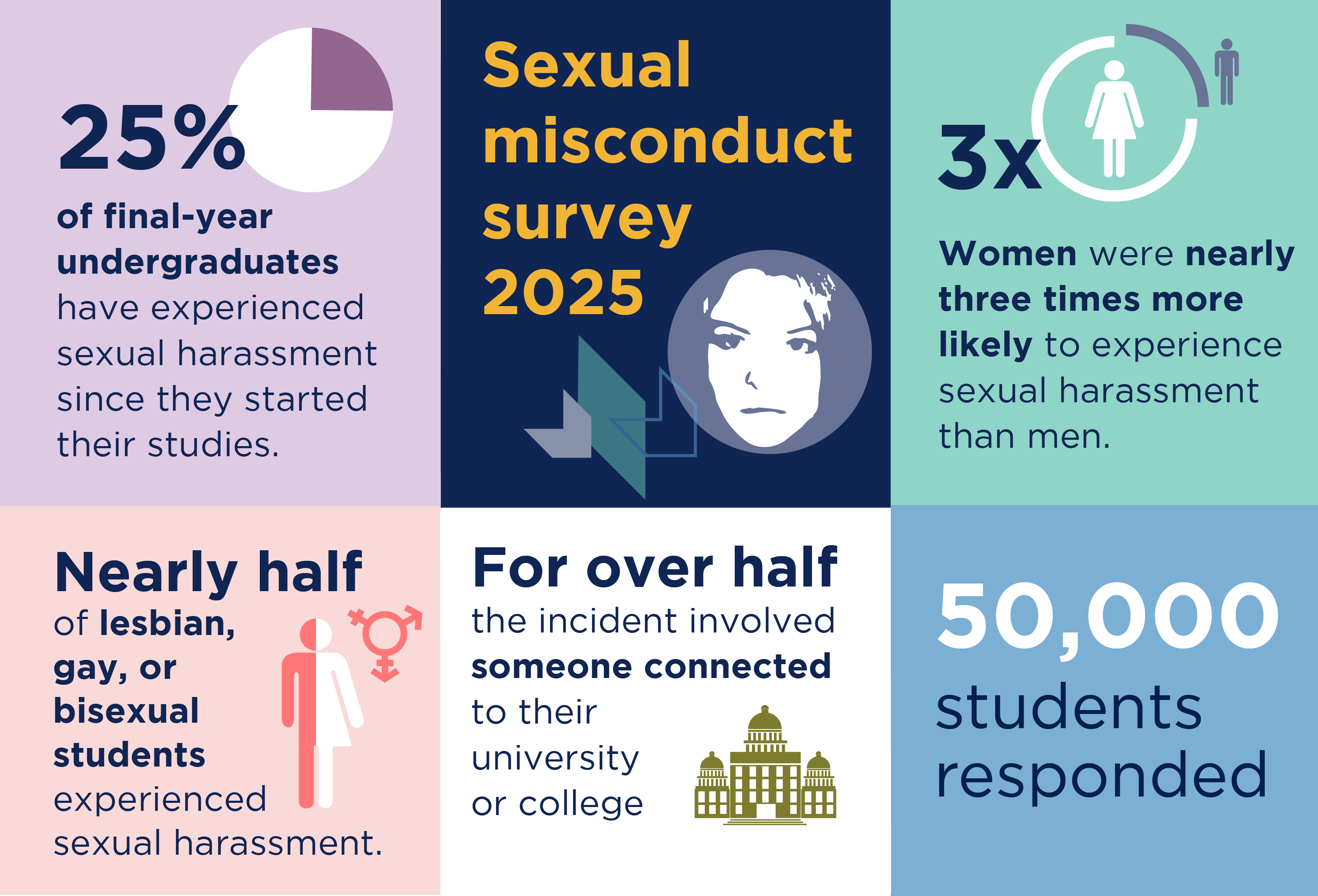
We ran the survey in 2025 at the start of the year. 50,000 students responded.
Our analysis of the responses shows that:
- Nearly a quarter of final-year undergraduates have experienced sexual harassment since beginning their studies.
- One in seven have experienced sexual assault or violence.
- Women were nearly three times more likely to experience sexual harassment than men. They were also more than twice as likely to experience sexual assault or violence.
- Nearly half of lesbian, gay, or bisexual students experienced sexual harassment, compared with 21.7 per cent of heterosexual students. They were also more likely to have experienced sexual assault or violence.
- Younger people and disabled students also reported significantly higher rates of sexual harassment and sexual assault or violence.
- Over half of respondents who experienced sexual harassment in the last 12 months said that the incident(s) involved someone connected to their university or college. A third reported that the identity of the perpetrator(s) was a fellow student.
We have also analysed the results by different student groups and study contexts. This builds on our analysis, adding more detail and context.
The analysis shows where patterns look consistent and where they vary. It does not explain the underlying causes or assess the approach at specific providers. But it may help providers to compare their own data with patterns across the higher education sector.
Some key findings from the research show that:
- Students studying veterinary sciences, or languages or area studies are more likely to experience sexual harassment and sexual assault/violence.
- Students at higher tariff universities are more likely to report an issue than students at other institutions.
- Students who report a mental health condition are also more likely to report experiences of sexual harassment and sexual assault/violence.
Why did we do this?
There is currently limited data on sexual misconduct affecting students in higher education in England.
Existing evidence includes quantitative data on the experience of crimes, small-scale surveys and polls, and research generally carried out at provider level.
The nature of this evidence means that we do not have reliable data on the extent or scale of the issue of sexual misconduct in higher education.
Our 2025 survey builds on our 2023 sexual misconduct pilot survey, which was sent to students from a small group of providers who volunteered to participate.
By surveying students on a larger, national scale, we hoped to:
- understand the prevalence of sexual misconduct experienced by students
- gain insight on how and where interventions might be targeted to tackle sexual misconduct
- test an approach to capturing prevalence data at a national level.
Evaluation
We have also evaluated the 2025 survey.
Overall, this found that the survey was practical with the potential to operate at scale. The survey also offers strong analytical benefits compared with other options.
It also found that we could improve the survey by:
- making the survey easier to access
- refining communications, boosting awareness and participation
- considering other methods to capture insights from excluded student groups.
Next steps
Findings from the survey suggest a need for further investigation to improve understanding.
We will run the sexual misconduct survey again within the National Student Survey in 2027. This will help build the base of evidence over time.
We also expect to publish provider-level data from the 2025 and 2027 surveys together.
Last updated 08 May 2026 + show all updates
08 May 2026 - We have updated the page with a summary of our analysis of the survey results by student groups and study contexts.
Describe your experience of using this website