
Professor Chris Millward, our interim Director for Fair Access and Participation, gave the keynote speech today at the Transforming Access and Student Outcomes (TASO) annual conference.
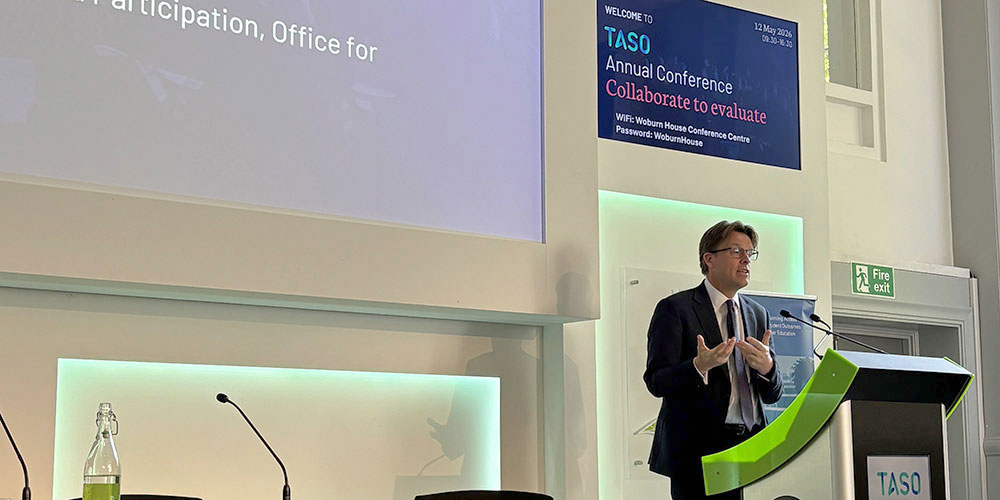
In his speech, he discussed regional collaboration considering the government’s recent post-16 education and skills white paper, what best practice collaboration looks like, and how it can support equality of opportunity in higher education.
Thanks to Omar [Khan] and TASO for the invitation to speak today.
I was closely involved in securing the funding for a ‘what works’ centre on higher education access and participation during the early years of the OfS, then the tender that led to the commissioning of the TASO consortium. There was widespread support in government and the sector for that investment, but also complex organisational arrangements as TASO became a charity separate from the leading university. This provided the independence necessary to work across a diverse sector with different missions and interests and gain the standing and learning for access and participation that comes with membership of the broader network of ‘what works’ centres.
On returning to this role at the OfS, reading access and participation plans and speaking to practitioners like yourselves, it’s great to see TASO’s work referenced across all parts of the sector from the most established universities to newly registering providers, bringing colleagues together, as today, to share approaches and findings, and providing resources to support, challenge and advance new methods. I’m grateful to colleagues in TASO for achieving this, not least in such changing conditions for our work on higher education access and participation.
Background to TASO
TASO exists due to a recommendation from the Social Mobility Advisory Group, which was appointed by the then Minister for Universities and Science in October 2015 and on which both Omar and I served. The group reported a year later, by which time a lot had changed.
In May 2016, the government published its white paper ‘Success as a Knowledge Economy’, which led to the 2017 legislation establishing the OfS, integrating access regulation and funding within one organisation and giving more explicit attention to successful participation and progression, alongside access.
The group’s first recommendation was the establishment of an independent ‘Evidence and Impact Exchange’. This would systematically evaluate and promote evidence relating to the role of higher education in supporting social mobility, building greater strategic coherence and co-ordination between all parties and allowing for more effective targeting of interventions at each stage of the student lifecycle.
That recommendation, which was motivated by perceptions that the sector was spending a lot of money on widening access without understanding its effects, has withstood the test of time, and I think we can say that TASO is delivering on the group’s intent.
Evaluating access and participation work
The climate for evaluating access and participation work has changed fundamentally during the last decade, and some of our assumptions about higher education and social mobility – the Group’s broader remit – have also changed. Much of the case for widening access to higher education during the early 21st century was rooted in the notion that globalisation, underpinned by communications technology and open markets was changing jobs, lives and communities. In this dynamic environment it would be hard to know the character or location of work and lie in the future, but university degrees could equip us for wherever that may lead. Whilst change may be unsettling, this open economy would reward qualifications rather than social background, so increasing access to higher education would enable social mobility.
With this backdrop, policy ten years ago focused more on opening-up competition and choice nationally and internationally than aligning with the needs of different places and communities. There was more focus on enabling social mobility out of communities than improving prospects within them. Whilst there are still good arguments for that vision of social mobility, there is less of a consensus for it.
Increasing access to higher education has benefited millions of young people but it has not reduced inequalities. Entry part-time and later in life has declined, giving more weight to sustained attainment gaps in schools and leaving some people and places feeling left behind. Alongside this, governments have needed to manage health and security crises with lasting effects on young people’s wellbeing and the cost of living. More young people are wanting to spend longer on their journey to university and to study and work locally.
Higher education, and the broader research and civic mission of universities, remain pivotal for navigating events like these, but their consequences demand that our access and participation work spreads the benefits of increasing participation beyond the direct highway from schools to universities.
That requires more coherent pathways through different types of post-compulsory education, alignment with the needs of different places across the country, and closer collaboration between universities and colleges to deliver this.
This, of course, is the approach proposed by the government’s post-16 white paper. It's an important theme for the Task and Finish Group the government established through the white paper and will be a priority for our approach to access and participation funding and regulation during the coming years.
How is that relevant to TASO?
TASO is intended to provide the basis for individual institutions to share insights, evidence and approaches for the benefit of all. This is not easy in a diverse and autonomous sector with intense competition for students and reputational standing. It requires recognition that different contexts and capabilities demand different approaches, and the empowerment of institutions and practitioners within them collectively to identify and address common challenges.
We do not want in the OfS to dictate the methods used for evaluation, but we will provide a platform for co-ordination and improvement through our funding of TASO and our expectations for collaborative partnerships and access plans.
One dimension of that will be the work we have funded through TASO and HEAT on the Higher Education Evaluation Library, or HEEL, which encourages institutions to share failures as well as successes, empowered by commitments to publish evaluation findings made in access and participation plans. Publication in HEEL is one way to demonstrate these commitments, but not the only one, and submission to HEEL is not the end point. We need actively to learn from findings and adapt our approaches over time.
Role of regional access partnerships
I expect the same spirit to run through our wider reforms to access and participation regulation and funding, building on Uni Connect and our national evidence on risks to equality of opportunity. We want to strengthen the co-ordinating role of regional access partnerships so they are empowered to identify priorities locally, to which institutional access and participation plans can respond. That should drive more collective activities and common targets between universities and colleges in local areas extending from outreach to course configuration where there is an appetite for that. This is alongside continued support for students, which is more important than ever and which we are looking at very closely.
Again, I don’t underestimate the challenges with delivering this across a diverse and competitive sector, but it is crucially absent from current plans, raising concerns about the efficiency of our work and its coherence for the learners and communities we want to benefit from it.
There are significant issues to be addressed before we implement this – how partnerships should be governed and accountable, which institutions should be involved in partnerships and the geographical level at which they are best constructed, and the financial basis for partnerships and scope of their activity. These are all issues we are discussing with the Task and Finish Group, and on which the OfS will say more in the autumn, so that changes to partnership funding can happen from 2027-28 and new access and participation plans beyond that.
These plans build on more than two decades of widening participation activity, and a practitioner community that is unrivalled anywhere in the world. So, I look forward to working further with all of you on this during the coming year.

Comments
Report this comment
Are you sure you wish to report this comment?